
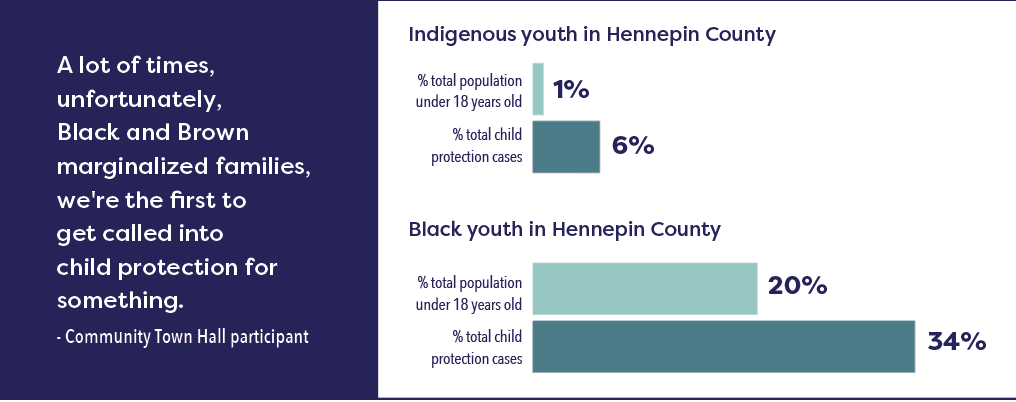
Right now, Black youth make up just 20% of all residents under 18 years old in Hennepin County — but 34% of child protection cases. Similarly, Native youth make up less than 1% percent of all youth, but 6% of child protection cases.
In collaboration with Hennepin County, the NAACP, and the Minnesota Child Welfare Training Academy, Research in Action (RIA) partnered to explore how to prevent family separation and develop systems that keep Black and Indigenous families together. We sought to understand:
How Black and Indigenous families come to the attention of Chlid Protection Services
How to prevent families from entering the system
And how to create pathways out of CPS for those that are in the system now
Nationwide, the United States’ child welfare system is characterized by a profound and persistent racial disproportionality, where Black and Indigenous families are significantly overrepresented at nearly every decision point, from initial reports to termination of parental rights. Research shows that this disproportionality is not due to higher rates of neglect within Black and Indigenous families; rather, it reflects the impacts of poverty, biased reporting, uneven service delivery, and other problematic practices that characterize Black and Indigenous parents’ interactions with CPS and related institutions.
What We Did
We hosted multiple Community Town Halls — including events focused on fathers and Indigenous families — to get input from impacted families
We interviewed seven key professionals in the child protection system, including CPS caseworkers and investigators
We collected data from 900 mandated reporters — people who work in schools, health clinics, and childcare centers — through an online survey
What We Found Out
“The anxiety is that we don’t know until we know it. No one taught us, we are just learning as we go.”
Families feel overwhelmed and confused because of outdated resources, long wait times, and pressure to comply with mandatory tasks — even when they don’t have enough time, information or support. For example, a town hall participant told us: “Had most of us known about the [FATHER] Project in the beginning, we’d be in a different place right now.” Mandated reporters said they thought families would get more resources once they entered the CPS system, but CPS workers agreed with families: there’s not enough support and the process is frustrating: “Hennepin County especially, we are a big system, so applying for any types of benefits can be really confusing to families. I have a master's degree—I get confused when I look at this stuff."
“When people come into the field doing this work, they have a hard time because they have their own bias of what they think a home should look like.”
Black and Indigenous families often feel targeted because mandatory reporters and CPS staff often misinterpret poverty for neglect or misinterpret cultural practices as suspicious. As one town hall participant said: “[They’re] just lacking the education and the knowledge on how to work with marginalized folks.” People in the child protection system agreed that personal bias about parenting as well as language and cultural barriers are real problems: “There's sometimes language and cultural barriers too. That can be a reason why we get a case.”
“CPS needs more access to classes… that don't charge us an arm and a leg.”
Families emphasized that barriers to stable housing, affordable mental health treatment, and money for food, childcare, and transportation drove their households into the CPS system. They also shared how expensive CPS requirements can be: “This is one of the two [parenting skills] classes I found that.. is actually free. Every other class I found charges $259 per session… I can't afford $259 a week. That's groceries.” Child protection workers agreed that families often just need basic resources — like rent and childcare — to stay out of the system: “Yeah, the resources that I think are important, in my experience, are resources that can provide financial assistance or giving out items such as household items..."
What We Can Do
Impacted families and systems professionals helped us identify key changes that can prevent family separation and create off ramps — like exiting the freeway — from CPS oversight in Hennepin County. Top recommendation included:
ELIMINATE RACIAL BIASES
Address racial bias by requiring cultural competency training for mandated reporters
Create and execute an evaluation plan for the new cultural competency training
Continue developing and expanding Limited English Proficiency services
Create a one-stop platform connecting County and Indian Child Welfare Act resources
CLARIFY SERVICES & RESOURCES
CPS should hire and train system navigators to support families
Agencies must regularly update information on services and waitlist times
Policymakers should require state-funded contractors to refer clients to community-based services when they reach capacity
Establish community advisory groups to incorporate lived experiences in program design and funding decisions
MITIGATE LIMITED RESOURCES
Counties should integrate resources and services into one updated platform
State should fund waivers or grants that can be used for multiple needs as they are identified
Counties should invest in accessible mental health and psychosocial support that doesn't require CPS involvement