
“It resonated with my whole life:” New Report on Justice in Institutions for Black Women, Girls, and Femmes Initiative
Cynthia Bobo has been the seeker and the support.
Decades ago, she crossed state lines to leave an abusive relationship and seek safety for herself and her children.
“When I came to Minnesota, I had four kids and I was living in a shelter,” she told us this summer. Like the participants in the Minnesota Family Investment Program that she helps administer today, she struggled to navigate the social services that were supposed to help her build a new, stable life.
“Black women like myself have always been on the bottom of the totem pole,” she said. “I've had to work harder than anybody else that wasn't Black. I've had to extend myself more than anybody that wasn't Black. So it comes normal, but I know it's not natural.”
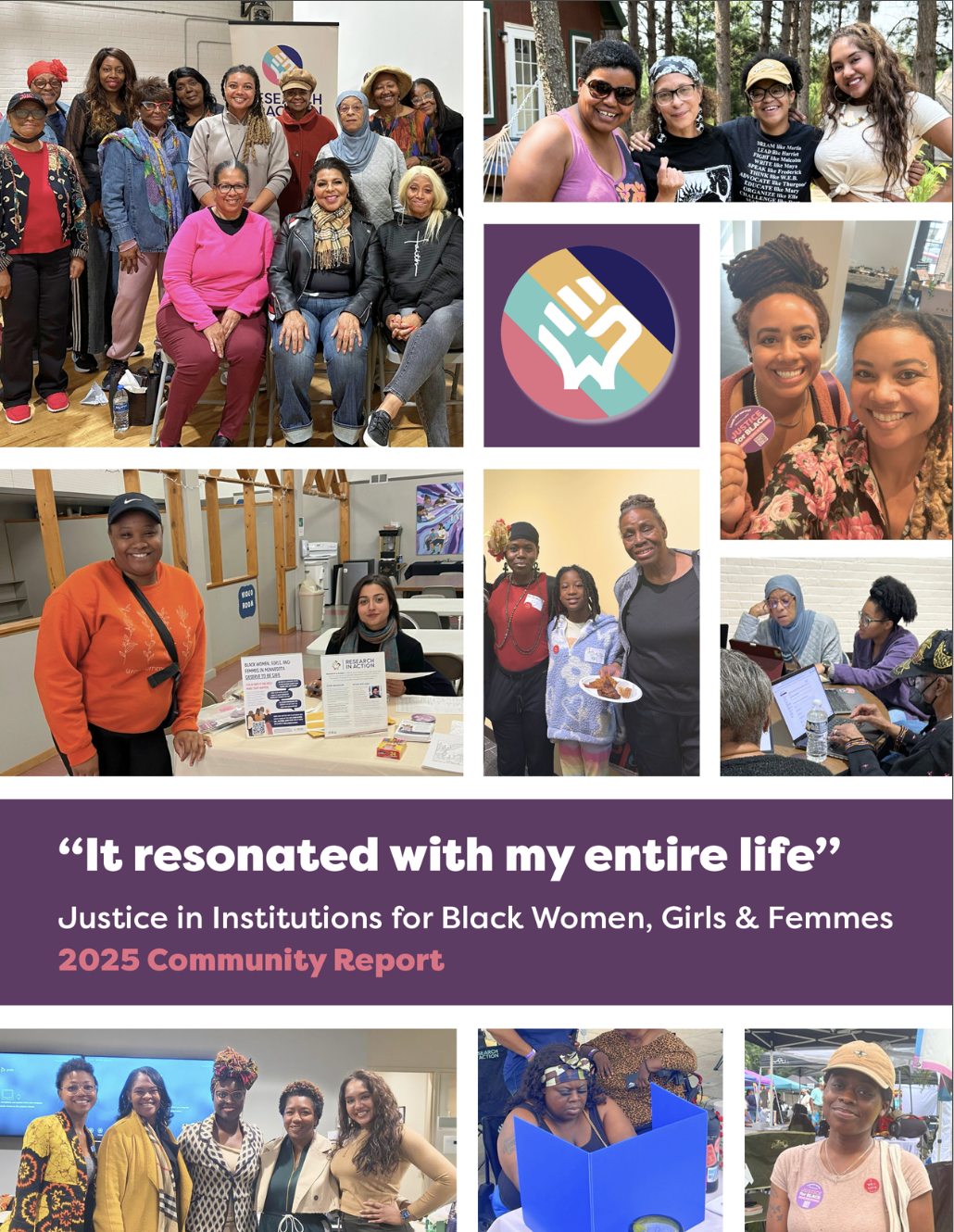
It’s not natural, but it is systemic. That’s why Research in Action is leading a five-year effort for Justice in Institutions for Black Women, Girls, and Femmes. Today, we’re releasing our 2025 Community Report.
Building on our work on Minnesota’s Missing and Murdered African American Women Task Force in 2021 and 2022, this project is a direct result of input from impacted communities. The Task Force report identified many persistent, systemic problems that make Black women and girls more vulnerable to violence than their white peers, but implementing the recommendations will take more research and engagement with Black women, girls and femmes statewide.
For Tiffany Roberson, a Safe Harbor worker and member of the Task Force Advisory Council, real change must happen on the front lines. “I’d like to see law enforcement and the hospitals really change their direction in how they deal with our cases that come through their offices,” she said. “As a whole, we need to change up how they've been treating us and how they've been lacking in meeting our needs.”
That’s exactly the focus of the Justice in Institutions Initiative. In 2024, when the Equity in Action Way Foundation (EAW) was awarded a Bush Community Innovation Grant, it contracted with RIA to undertake a five-year process to create a report card for the State of Minnesota and all its counties to gauge the success of their programs and guide innovative changes to ensure they serve the needs of Black women, girls, and femmes.
The first step towards creating the report card was to develop and conduct a statewide survey to get a baseline measure of how Black women, girls and femmes across Minnesota experience systems and institutions that contribute to unsafe conditions. The survey explored Black women, girls, and femmes’ experiences with and perceptions of these institutions like housing, healthcare, education, and criminal justice systems — including their levels of confidence and stress when they interact with them.
But we didn’t create the survey on our own: we designed it with feedback from impacted community members. As Cynthia Bobo told us when she took the survey in August 2025, she said: “They told me Black women helped them write the [survey] questions; I can tell. It resonated with my entire life. It actually gave me goosebumps that somebody would even be asking these particular questions.”
“It resonated with my entire life. It actually gave me goosebumps that somebody would even be asking these particular questions.”
Connecting with women like Cynthia was only possible because of deep and intentional collaboration with community members, leaders and organizations who co-developed the survey and shared it in spaces where Black women, girls and femmes would have easy access. The 2025 Community Report not only details the survey design process but also the intentional efforts to build authentic partnerships with organizations and leaders that serve Black women, girls, and femmes — not only in the Twin Cities but in Greater Minnesota, as well.
“One of the main learnings of year one was how to put community first in the ways we craft outreach and engagement strategies for data collection,” said Cori Knuckles, Statewide Partnerships and Impacted Community Leaders Coordinator, at Research in Action. “Right now, organizations that serve Black women, girls and femmes are losing funding and are rightfully cautious about taking on more work without knowing it will be of real value to their communities. So we knew that sending a mass email or even calling folks to invite them into the project wasn’t going to work. Instead, we approached organizations with genuine curiosity and a true desire to learn about their work and their programs to mutually identify how and whether their work aligned with what we’re doing.”
“We knew that sending a mass email or even calling folks to invite them into the project wasn’t going to work. Instead, we approached organizations with genuine curiosity and a true desire to learn about their work and their programs to mutually identify how and whether their work aligned with what we’re doing.”
“We also learned a lot about communities in Greater Minnesota,” said Emily Cavazos, Quantitative Research Specialist and Project Manager for the Justice in Institutions initiative. “For too long, metro organizations have dropped into more rural areas to extract data and tokenize stories, rather than make a real effort to understand and amplify the different experiences of Greater Minnesota residents. So we had to both explicitly acknowledge that history and demonstrate that we would not just listen to their feedback but take action. For instance, one partner noted that many African immigrant and refugee communities in Greater Minnesota speak Swahili — but we only had the survey in English and Somali. Even though there were only a few weeks left in the survey period, we listened and actively invested not only time but dollars to ensure the survey was available in Swahili.”
Ultimately, 767 participants completed the survey, far surpassing our goal of 600. Learn much more about the process, read more stories of impacted women and find out what’s next for the Justice in Institutions Initiative in the 2025 Community Report!
Join our Statewide Coalition Meeting on February 12 to get involved!